


Search how long should you brush your teeth and the answer comes back the same every time: two minutes. It's the right answer for a conventional toothbrush. The American Dental Association's consensus recommendation is two minutes, twice a day, with a soft-bristled brush and a fluoride toothpaste. Fewer people can say where that number came from, and almost nobody hits it without a timer.
This guide looks at what those two minutes actually measure: where the number comes from, how far most people fall short, and why the clock is a proxy for something harder to see. We'll also be clear about where Feno's 20-second cycle fits, and what independent research does and doesn't say about faster brushes.
TL;DR
- The ADA consensus is two minutes, twice a day, with a soft brush and fluoride toothpaste.
- Plaque studies show longer brushing removes more plaque, with gains flattening around two minutes.
- Most people brush far less than they think, and skip the inner surfaces most of all.
- Time is a proxy for coverage. Angle, gentle pressure and reaching every surface decide the result.
Chapter 1 of 6
How long should you brush your teeth, according to the ADA
The ADA's position is plain. Its toothbrush guidance says the consensus recommendation is to brush for two minutes, twice a day, with a soft-bristled brush (American Dental Association). The CDC's advice for adults is to brush well twice a day with fluoride toothpaste, floss, and visit a dentist at least once a year (CDC).
Fluoride deserves its own sentence, because Feno Foam is fluoride-free. The ADA and the CDC recommend fluoride toothpaste for cavity prevention, and that's the evidence-based default. If you've chosen a fluoride-free paste, make that call with your dentist. It isn't a reason to shorten the two minutes.
Where the two minutes came from
The number isn't arbitrary. It comes from experiments that timed plaque removal. In a 1993 Amsterdam study, an investigator brushed volunteers' teeth for 7.5 to 90 seconds per quadrant with four different brushes. Plaque removal climbed with time for every brush. The manual brush went from about 40 percent plaque reduction at the shortest setting to about 75 percent at the longest (J Clin Periodontol, 1993).
A 2009 study of 47 adults brushing without instruction found the same curve. Brushing for 120 seconds removed 26 percent more plaque than 45 seconds, and 180 seconds removed 55 percent more than 30 seconds, with the gains tending toward a maximum at longer times (J Dent Hyg, 2009). The ADA cites that study when it says two minutes achieves clinically significant plaque removal. The curve rises, then it flattens.
Two minutes is an evidence-based minimum for a hand-held brush, not a magic number. Plaque removal rises with time and then levels off.
Chapter 2 of 6
What the clock is really measuring
Here's the part that gets lost. Those studies didn't find that time removes plaque. They found that time gives a small brush head the chance to visit more surfaces. Two minutes is a proxy. It stands in for coverage, which is hard to measure at a bathroom sink.
A systematic review of 59 manual-brushing studies put numbers on it. A single brushing session removed 42 percent of plaque on average: 27 percent after one minute, 41 percent after two (Int J Dent Hyg, 2012). A 2025 meta-analysis reached the same conclusion for both manual and powered brushes, with moderate certainty that two minutes beats one (Int J Dent Hyg, 2025).
The two minutes were never the goal. They're the time a hand-held brush needs to reach every surface.
Why the curve flattens
Look at where the plaque stays. In a study of 94 adults brushing for one minute, the outer, cheek-side surfaces were 69 percent cleaner afterward. The inner, tongue-side surfaces were only 21 percent cleaner (J Clin Periodontol, 1998). Extra seconds help mostly because they're more likely to land on surfaces you skipped the first time. Seconds spent re-polishing your front teeth don't.
That's also why faster brushing isn't automatically worse and longer brushing isn't automatically better. What matters is what happens during the seconds. We walked through how simultaneous cleaning changes that math in Does Brushing Longer Clean Your Teeth Better?, so we won't repeat it here.
Time predicts plaque removal because it predicts coverage. Judge a brushing session by the surfaces it reached, not the seconds it took.
Chapter 3 of 6
How long most people actually brush
Knowing how long to brush teeth is the easy part. Doing it is another matter, and the research here is humbling.
In 1985, researchers videotaped 60 uninstructed young adults brushing. The mean time was 33 seconds (Community Dent Oral Epidemiol, 1985). The 2009 study the ADA cites described typical brushing time in the general population as closer to 45 seconds (J Dent Hyg, 2009).
Even longer brushers skip the same places
Newer studies look better on the clock but not on coverage. When 103 German adults brushed while a computer recorded their habits, the mean duration was about 97 seconds, and nearly 80 percent said they brushed twice a day. Yet only one in four brushed twice daily, for 120 seconds, with gentle force and a reasonable technique (Clin Oral Investig, 2009).
A video study of 101 eighteen-year-olds found a mean brushing time of about two and a half minutes. The problem was distribution. Participants spent about 72 seconds on outer surfaces and about 27 seconds on inner surfaces, a pattern the authors noted was similar to recordings from the 1970s (Clin Oral Investig, 2015). More time, same blind spots.
Most people brush for well under two minutes, and the people who brush longer still miss the same surfaces. The shortfall is coverage first and time second.
Chapter 4 of 6
Technique, pressure and coverage beat the stopwatch
If time is a proxy, the thing it stands for is within reach. The ADA's technique guidance is short: hold the brush at a 45-degree angle to the gums and move it in short, tooth-wide strokes (ADA MouthHealthy). Whatever technique you use, brushing should touch every surface: inner, outer and chewing. For the inside of the front teeth, tilt the brush vertically and use several up-and-down strokes (American Dental Association).
Pressure matters too, in the other direction. The ADA recommends a soft-bristled brush and gentle pressure to reduce the risk of gum injury. The force study above found that plaque removal improved with force only up to a point, roughly 400 grams in that test, and fell off when people pressed harder (J Clin Periodontol, 1998). Scrubbing harder is not a substitute for reaching further.
A two-minute session that actually covers the mouth
One practical way to spend the two minutes is to split the mouth into four sections and give each about 30 seconds, working the outer, inner and chewing surfaces before moving on. The point isn't the pacing. It's that each section gets its own turn, including the inner surfaces people skip.
Then finish the job a brush can't do. Clean between your teeth once a day, because bristles don't reach there (ADA). Replace the brush every three to four months, or sooner if the bristles fray. Keep your dental visits: the CDC says at least once a year, and your dentist may suggest more (CDC). If your gums bleed regularly or stay sore, that's a reason to see a dentist, not to brush harder.
Angle, gentle pressure and a deliberate path across every surface are what the two minutes are buying you. Floss daily and keep your dental visits; no brush replaces either.
Chapter 5 of 6
Powered brushes, timers and what they change
A powered brush doesn't shorten the answer to how long should you brush your teeth for. The 2025 meta-analysis found two minutes beat one minute for powered brushes as well as manual ones (Int J Dent Hyg, 2025). The ADA says either type can be used effectively (American Dental Association).
Powered brushes do carry a modest edge over time. A Cochrane review of 56 trials found that, compared with manual brushing, powered brushes reduced plaque by 11 percent at one to three months and by 21 percent beyond three months, with gingivitis reduced by 6 and 11 percent over the same periods, on moderate-quality evidence (Cochrane Database Syst Rev, 2014). The review didn't separate out why.
What a timer can and can't tell you
A two-minute timer solves the most common failure, which is stopping too soon. A quadrant pacer solves the second, which is spending the whole two minutes in one place. Neither can tell whether the bristles touched the inside of a lower molar. The timer measures the proxy. Coverage is still on you.
Pressure sensors get closer, because pressing too hard is a measurable error (J Clin Periodontol, 1998). Even then, the sensor knows how hard you pressed, not where.
A powered brush with a timer helps you reach two minutes, and the evidence favors powered brushes modestly over time. It still can't confirm which surfaces got cleaned.
Chapter 6 of 6
Where Feno's 20-second cycle fits
Feno approaches the proxy problem from the other side. Instead of asking you to carry one small brush head to every surface over two minutes, the Feno Smartbrush uses a TrueFit Mouthpiece with about 18,000 ultra-soft nylon bristles on a flexible plate, designed to clean all accessible tooth surfaces at the same time. The mouthpiece comes in seven sizes, and you scan your mouth with the Feno app after purchase to get matched to one.
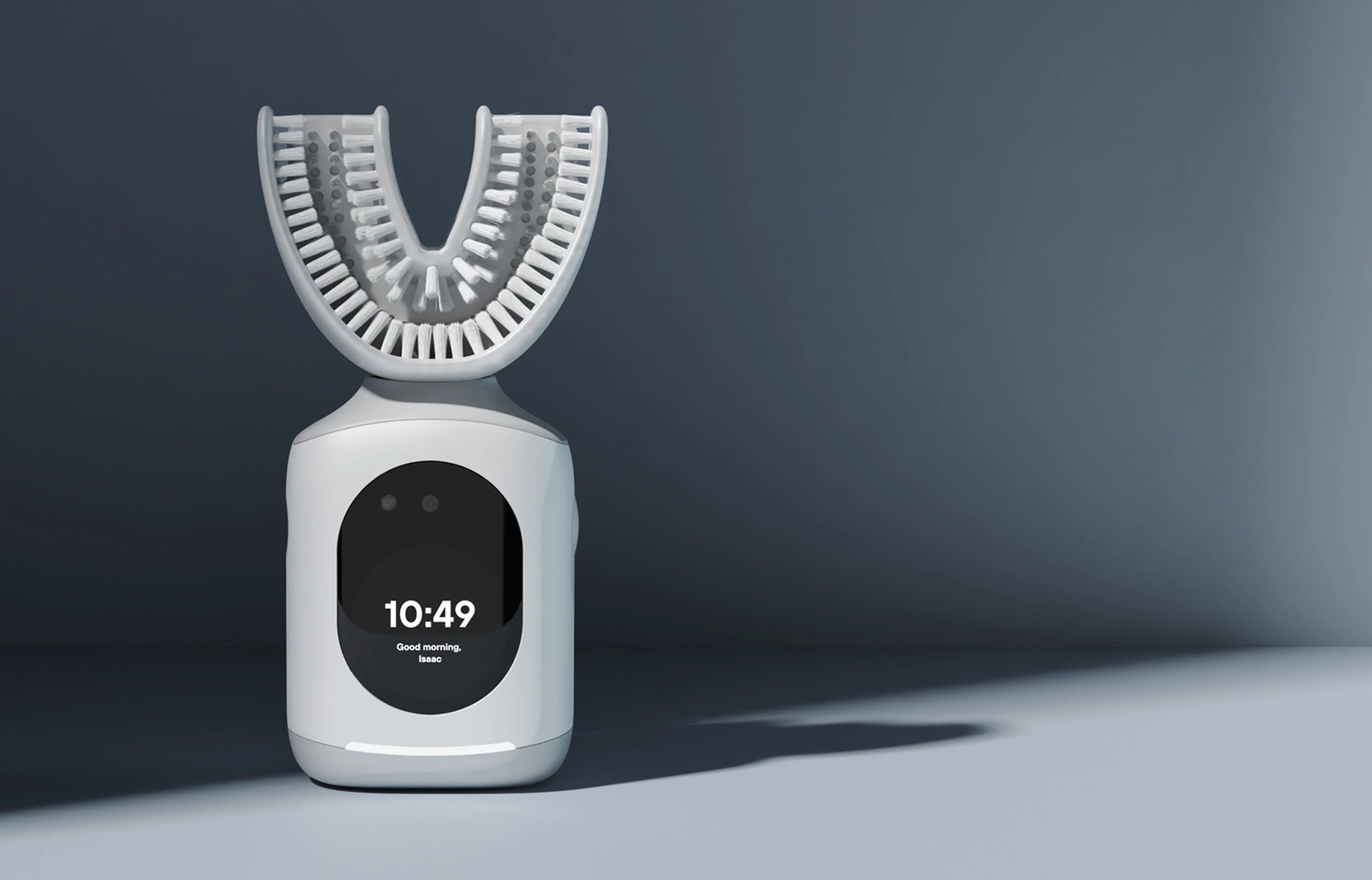
The cycle is programmed, not guessed. It runs for 20 seconds and delivers 250 strokes per cycle, according to Feno's current product specifications. Feno recommends biting down gently and moving the mouthpiece in a slow circular motion while it runs, and the Smarthandle shows a warning if bite pressure gets excessive. Connected, it sends your brush and streak data to the Feno app, which is optional; the brush is fully functional without it. Timing, in other words, is handled for you. Coverage depends on fit and on that gentle circular motion.
What the research does and doesn't say about faster brushes
This is where a Feno post has to be careful. Independent randomized trials of other U- and Y-shaped automatic brushes have mostly found they removed less plaque than conventional brushing. In one 2020 crossover study, a U-shaped automatic brush did no better on plaque than skipping brushing entirely (Int J Environ Res Public Health, 2020). In a 2024 trial, a Y-shaped brush did better than nothing yet left more plaque behind than either 45 or 120 seconds with a manual brush (Clin Oral Investig, 2024). Two Austrian pilot studies traced the gap to fit: bristle rows that didn't reach the teeth in places, and a head too short to cover the second molars in 95 percent of participants (Clin Oral Investig, 2021; Clin Oral Investig, 2023). In the 2023 study, running the device three times longer per jaw brought plaque removal up to the level of manual brushing.
None of those studies tested Feno. That cuts both ways: they don't condemn Feno's design, and they don't validate it either. They do explain its design choices: seven sizes matched by scan instead of one universal tray, nylon bristles on a plate that flexes to the arch, and a 20-second cycle rather than a 5- or 10-second pass. Feno reports internal product testing, not a published trial, so treat the 20 seconds as a design claim backed by specifications, not a proven equivalent of two minutes. You'll still need to floss once a day, and no brush replaces a dental exam.
Feno handles the timing and aims at coverage through fit. Independent trials of other mouthpiece brushes were disappointing, and none tested Feno, so judge it on fit and contact, not on the clock.
The Bottom Line
Frequently Asked Questions
Is Brushing for 2 Minutes Enough?
Is It Bad to Brush Your Teeth for Too Long?
How Long Should You Brush Your Teeth With an Electric Toothbrush?
Does the Feno Smartbrush Really Clean Your Teeth in 20 Seconds?
Featured Posts
View all
Feno vs Autobrush vs Y-Brush: U-shaped toothbrushes compared
Read article
Toothbrush Head Size: Does Bigger or Smaller Clean Better?
Read article
Floss before or after brushing? The right order, explained
Read article
What Dentists Are Saying About Feno
Read article
Why Does Bad Breath Come Back After Brushing?
Read article