Picture a toothbrush that isn't a brush at all. It's a tray shaped like your dental arch, lined with bristles on both sides. You bite into it, press a button, and every tooth gets brushed at once. That's a U shaped toothbrush, and the promise that comes with it is a full clean in 20 to 30 seconds instead of two minutes.
The idea is sound. The execution is harder. Several independent clinical trials have tested U-shaped and Y-shaped automatic brushes against ordinary brushing, and most found the automatic device removed less plaque. None of them tested Feno. We make a U-shaped brush; read on knowing that. We'd still rather show you the evidence than a pitch, because the same studies that found problems also spell out what a U-shaped brush for adults has to get right.
TL;DR
- A U-shaped brush surrounds every tooth with bristles and cleans all of them in one short cycle.
- Most independent trials found early U- and Y-shaped brushes removed less plaque than manual brushing.
- The failures traced to fit, bristle contact, bristle type and cycle time, not to the shape itself.
- Feno's design targets those four points, but no published trial has tested Feno yet.
Chapter 1 of 6
How a U shaped toothbrush works
A conventional toothbrush head cleans one small patch at a time, and you move it around for two minutes to cover everything. A U-shaped toothbrush flips that. The head is a mouthpiece molded to the curve of a dental arch (the U-shaped row your teeth form in each jaw), with bristles on the inner walls facing the teeth. Bite into it and bristles sit against the outer, inner and chewing surfaces of your teeth at the same time.
A motor in the handle then moves the bristles. In most devices that's sonic vibration, a rapid buzz carried through the mouthpiece. Some use small translational strokes that slide the whole bristle bed across the teeth instead. Either way the instruction is the same: bite gently, keep the device moving slightly, let the cycle run. Cycles last from about 10 seconds to a minute.
Two arches at once, or one at a time
U-shaped brushes cover the upper and lower arches together. Y-shaped brushes do one arch at a time. Both are called automatic or auto-cleaning toothbrushes in the research, and both are regulated like any electric toothbrush: as a Class I powered toothbrush under 21 CFR 872.6865, a registration and listing category rather than a clearance or approval. No U-shaped brush is "FDA approved."
Cheap manual U-shaped brushes exist too, mostly sold for children. In one children's trial, a manual U-shaped brush removed no more plaque than not brushing at all, while a battery-powered regular brush did best (Int J Clin Pediatr Dent, 2025).
A U-shaped brush trades sequential scrubbing for simultaneous contact, so its whole case rests on whether the bristles actually touch every surface.
Chapter 2 of 6
What the independent research found
This is the part most U-shaped brush marketing skips. Between 2020 and 2025, university groups in Italy, Austria and Belgium ran randomized trials pitting automatic U- and Y-shaped brushes against manual or conventional powered brushing. Most results went against the automatic devices.
The first widely cited trial came from Florence. Twenty-two students brushed four ways in a crossover design: a U-shaped automatic brush, a conventional powered brush, their own habitual brushing, and no brushing. The U-shaped brush removed far less plaque than the other two methods, and its result was not statistically different from not brushing (Int J Environ Res Public Health, 2020). The authors' conclusion: the device "proved to be not effective in removing dental plaque."
The pattern held across devices and labs
An Innsbruck group tested a "ten seconds" auto-cleaning device against uninstructed manual brushing in 20 adults. Full-mouth plaque reduction was 11.37% for the device and 31.39% for manual brushing (Clin Oral Investig, 2021). The same group later tested a Y-shaped device with nylon bristles: at 5 seconds per jaw it removed less plaque than manual brushing, but at 15 seconds per jaw the result became comparable (Clin Oral Investig, 2023). Back in Florence, a Y-shaped brush beat no brushing but lost to manual brushing at either 45 or 120 seconds, and was no better than a U-shaped brush (Clin Oral Investig, 2024). In Belgium, a U-shaped electric brush removed less plaque than single-headed and triple-headed manual brushes, though users rated it the most comfortable (Int J Dent Hyg, 2025).
Two smaller studies muddy the picture. In adults with Down syndrome brushing unassisted at home, a Y-shaped device and an oscillating-rotating brush ended with similar, unsatisfactory plaque control (Clin Oral Investig, 2025). A non-randomized pilot in a long-term care home found an automatic brush lowered biofilm and gingivitis more than residents' regular brushing (Spec Care Dentist, 2024). Hints, not verdicts. And none of these studies tested Feno; no peer-reviewed trial of Feno has been published.
In head-to-head trials, the early automatic U- and Y-shaped brushes mostly cleaned worse than a manual brush used for two minutes.
Chapter 3 of 6
Why those brushes underperformed
You could read those trials and conclude the U shape doesn't work. The researchers didn't. In almost every paper the explanation was mechanical, and it comes down to four variables.
- Fit: a one-size tray can't match every arch, so some bristles float above the teeth while others jam.
- Bristle contact: rows that don't reach the gumline or the back molars clean nothing there.
- Bristle type: researchers singled out devices with nylon filaments, the material in ordinary brushes, as having "future potential" to match manual brushing.
- Time and motion: a 5- or 10-second cycle held still is a very short brush, however many teeth it touches.
The Innsbruck team put the device's mouthpiece on dental casts and traced where the bristles touched. At most two of its four bristle rows contacted tooth surfaces, and in some areas the bristles touched nothing. Cleaning was good where bristles met enamel and poor everywhere else (Clin Oral Investig, 2021). Their conclusion named the fix: "the alignment and density of the auto-cleaning device's bristle rows need to be improved, and assorted sizes would be necessary to cover different jaw shapes."
Each variable showed up in a result
Fit explains the molar problem. In the nylon-bristle Y-brush study, the device was too short to fully cover the second molars in 95% of participants, and the gingival margin (the edge where tooth meets gum) was uncovered on about 31% of teeth (Clin Oral Investig, 2023). Those are exactly where plaque causes trouble; our post on why toothbrush fit and design matter goes deeper.
Time explains the dose problem. In that same study the gap with manual brushing disappeared when the cycle went from 5 to 15 seconds per jaw. Even the manual result depended on time: two minutes removed significantly more plaque than 45 seconds (Clin Oral Investig, 2024). Simultaneous contact changes the math on time, but it doesn't erase it. More on that in Does Brushing Longer Clean Your Teeth Better?
The trials indicted specific design choices (loose fit, missing contact, too few bristles touching teeth, tiny cycles), not the idea of brushing every tooth at once.
Chapter 4 of 6
Why fit to an adult arch matters most
Of the four variables, fit decides the other three. If the mouthpiece doesn't match your arch, bristle density is irrelevant where the bristles don't reach, and extra seconds just buzz against air.
Adult dental arches vary a lot. Jaw width, arch depth, molar position, crowding, rotated teeth, crowns, missing teeth and gumline shape all differ from person to person. A tray built around an average adult mouth will be too short for a long arch (uncovered molars) and too wide for a narrow one, where bristles splay outward instead of pressing in.
Manufacturers must focus on improving an accurate fit. (Clin Oral Investig, 2023)
What good fit has to deliver
The research gives a checklist. Bristles must reach the second molars, which the Y-brush authors found they often don't, prompting the conclusion quoted above (Clin Oral Investig, 2023). Bristles must sit at the gingival margin, which is why the ADA has you angle a regular brush 45 degrees toward the gums (ADA, MouthHealthy). And bristles must press, not float, which depends on the mouthpiece walls matching your arch width.
So the brush has to be sized to you. A one-size mouthpiece is a guess. A mouthpiece chosen from several sizes using a measurement of your own arch is a fit. Plaque doesn't care which one you paid for; it cares whether a bristle touched it. If you still see plaque after brushing, this post covers the usual reasons.
An adult U-shaped brush lives or dies on fit: reach to the back molars, contact at the gumline, and walls that match your arch width.
Chapter 5 of 6
How Feno's design addresses those points
This chapter describes how the Feno Smartbrush is built against that checklist. It doesn't claim the design has been proven in a trial. Feno reports its own internal testing, but no peer-reviewed study has tested Feno. Judge what follows on the logic.
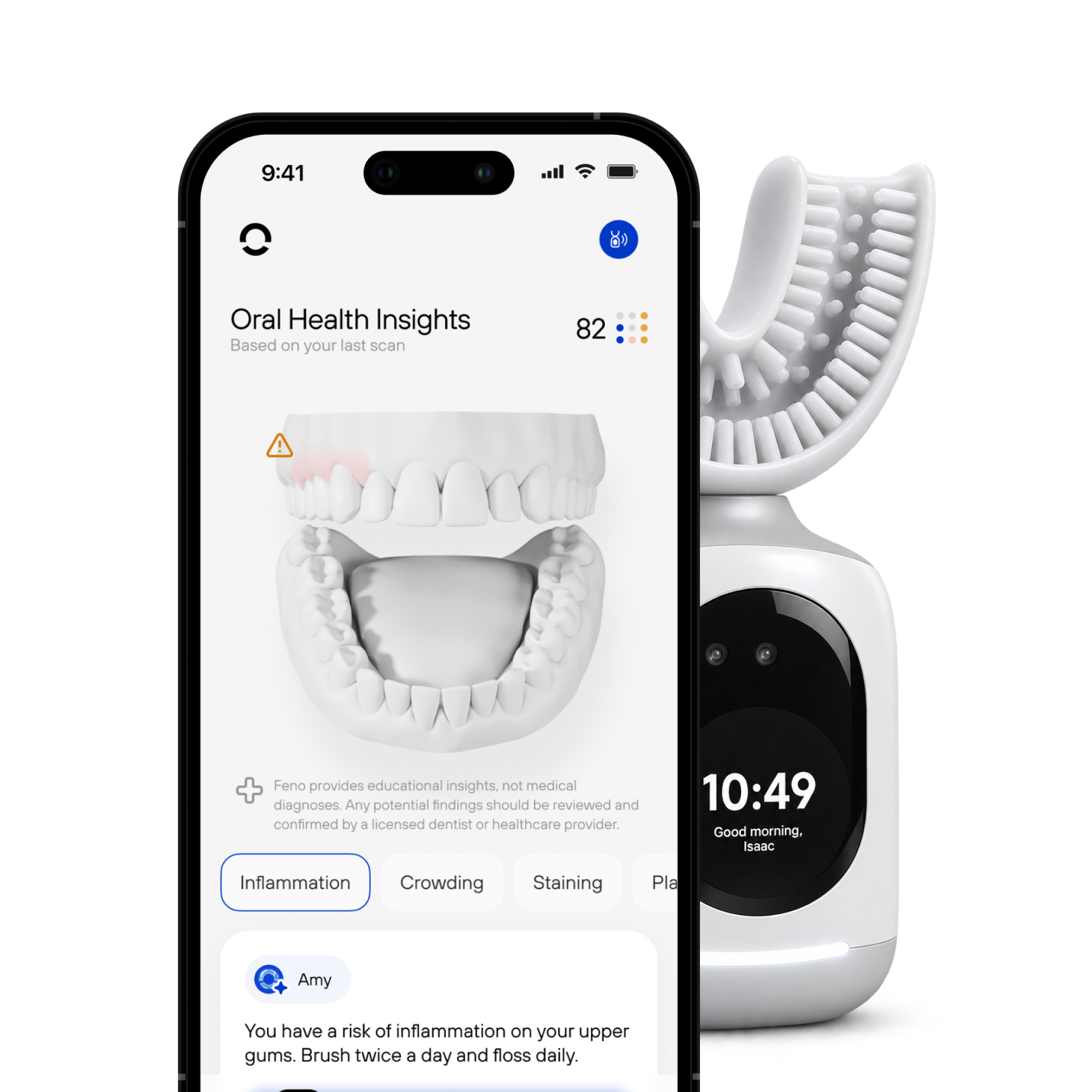
On fit, Feno doesn't ship one tray. The TrueFit Mouthpiece comes in seven sizes. After purchase you scan your mouth with the Feno app, which matches you to the size that best fits your arch. Your first two size exchanges are free. The bristle plate is semi-pliable, so it flexes to the arch rather than holding a rigid curve.
Bristles, motion and time
On bristle type, each mouthpiece carries about 18,000 ultra-soft nylon bristles, the same material as an ordinary toothbrush. On motion, the Smartbrush doesn't rely on typical vibration. It uses gentle translational movements designed to clean all teeth at once, with intensity you can adjust in the app or on the handle. And you're not meant to hold still: bite down gently and move the mouthpiece in slow circular motions so the bristles keep contact, including on the back molars. A cycle runs 20 seconds and delivers 250 strokes.
Two honest caveats. The 20-second figure is Feno's product specification, and the trials show time matters even for simultaneous brushing, so run the full cycle and keep moving. And Feno is registered and listed with the FDA as a Class I powered toothbrush, like every electric toothbrush; it isn't FDA cleared or approved and doesn't carry an ADA Seal. Feno isn't recommended for anyone with active braces, a crown placed within the last four weeks, or a pacemaker. If you have gum recession or another gum condition, check with your dentist first. A separate side-by-side puts Feno next to the other U-shaped brushes if you want specifics.
Feno answers the trials' four problems with sizing by scan, nylon bristles, a translational motion you keep moving, and a 20-second cycle; none of that has yet been tested in a published study.
Chapter 6 of 6
Who a U-shaped brush suits, and how to use one well
So are U-shaped toothbrushes good, and for whom? For the adult who will use one correctly and consistently, and who wasn't brushing well before. A 2026 systematic review found uninstructed adults brush with a manual toothbrush for about 87 seconds on average, short of the two minutes the ADA recommends (Int J Dent Hyg, 2026). A brush that covers every tooth in one guided cycle removes the "where did I skip" problem, if it fits and you run it properly.
The research groups kept pointing at people with limited dexterity, intellectual disabilities or caregiver-dependent routines as the group that could benefit most, because for them a two-minute routine often doesn't happen at all (Clin Oral Investig, 2024). If that's you or someone you care for, a well-fitted automatic brush is worth a conversation with your dentist.
Getting the most out of any U-shaped brush
Run the whole cycle every time and keep the mouthpiece moving as directed; the trials show static, short cycles are where plaque survives. Replace the mouthpiece on schedule; the ADA says to replace a toothbrush every three to four months or sooner if bristles fray (ADA). And use a fluoride toothpaste unless your dentist says otherwise; that's the ADA position on preventing cavities.
Keep cleaning between your teeth once a day. No U-shaped brush reaches between teeth, and the ADA recommends daily interdental cleaning no matter which toothbrush you use (ADA, MouthHealthy). And keep your dental visits. Nearly half (42%) of US adults 30 and older have periodontitis, gum disease that has begun to damage the bone around the teeth (CDC). A toothbrush of any shape cleans teeth. It doesn't diagnose or treat disease.
A U-shaped brush suits adults who weren't brushing well before and will run it as directed; it never replaces flossing, fluoride or a dentist.
The Bottom Line
Frequently Asked Questions
Do U-Shaped Toothbrushes Work?
Are U-Shaped Toothbrushes Good for Adults?
Can a U-Shaped Toothbrush Replace Flossing?
How Long Should a U-Shaped Toothbrush Cycle Be?
Featured Posts
View all
Feno vs Autobrush vs Y-Brush: U-shaped toothbrushes compared
Read article
Floss before or after brushing? The right order, explained
Read article
Plaque vs tartar: what you can remove at home
Read article
Gum Disease and Atrial Fibrillation: What a 2024 Study Found
Read articleA Functional Dentist's Take on Feno: Dr. Staci Whitman's Review
Read article