

Gum disease stages used to be described in loose words. Gingivitis. Early. Moderate. Advanced. But since the 2017 World Workshop of the American Academy of Periodontology (AAP) and the European Federation of Periodontology (EFP), there's a more exact system behind them. Periodontitis is staged from I to IV and graded from A to C.
This guide walks through each stage in order: what the dentist is measuring, what you'd notice, which part of the damage can be undone, and what treatment looks like. Just the criteria the profession uses, and the habits that keep you at the healthy end of the scale.
TL;DR
- Gingivitis is gum inflammation with no attachment loss, and it's reversible with daily cleaning plus a professional cleaning.
- Periodontitis is staged I to IV by how much attachment and bone have been lost at the worst tooth.
- Grades A to C estimate how fast the disease is moving, with smoking and diabetes as the two modifiers.
- About 42% of US adults 30 and older have periodontitis, so get a dental check-up at least yearly.
Chapter 1 of 6
What the gum disease stages actually measure
Gum disease starts with plaque. The NIDCR describes periodontal (gum) disease as "an infection that causes inflammation of the tissues that hold your teeth in place." Plaque, a sticky film of bacteria, builds up along the gumline. Leave it there and it can harden into tartar, which brushing can't remove.
Early on, the inflammation stays in the gum tissue. That's gingivitis. If it continues, it can start breaking down the fibers and bone that anchor the tooth. That's periodontitis. The difference between the two isn't how red your gums look. It's whether attachment has been lost.
The 2017 classification replaced the old labels
In 2017 the AAP and the EFP held a World Workshop that produced the classification dentists use today (J Periodontol, 2018). The old split between "chronic" and "aggressive" periodontitis was dropped. Periodontitis is now a single category described two ways. A stage captures how severe it is and how complex it will be to treat. A grade captures how fast it's likely to progress and what's driving it (J Periodontol, 2018).
It's common. The CDC reports that nearly half (42%) of adults aged 30 and older have periodontitis, and about 8% have the severe form. The national survey behind those numbers found 7.8% with severe disease and 59.8% of adults 65 and older affected (J Am Dent Assoc, 2018). The CDC also calls periodontitis a leading cause of tooth loss.
Gingivitis is inflammation of the gum only; periodontitis means the support around the tooth has started to break down, and dentists stage that breakdown from I to IV.
Chapter 2 of 6
Gingivitis: the stage you can reverse
Gingivitis isn't numbered. It sits before Stage I, because no attachment has been lost yet. The 2017 workshop builds the case definition of gingivitis mainly on one sign: bleeding when the dentist gently probes the gum (J Clin Periodontol, 2018). The signs you'd notice at home are the ones the ADA lists:
- Gums that bleed when you brush, clean between your teeth, or eat something hard
- Red, swollen, or tender gums
- Persistent bad breath or a bad taste
- Often, nothing you'd notice at all
The clinical threshold is specific. A patient with an intact periodontium is a gingivitis case when 10% or more of probed sites bleed. From 10% to 30% is called localized, and above 30% is generalized (J Clin Periodontol, 2018). The AAP describes gum disease as "often silent", with symptoms that may not appear until the advanced stages.
Gingivitis is inflammation you can reverse. Periodontitis is damage you can only manage. The line between them is attachment loss.
Why it's reversible
The gum is inflamed, but the bone and the fibers underneath are intact. The NIDCR puts it plainly: "Early gum disease, caused by plaque buildup, can often be reversed by daily brushing and flossing." The ADA adds that a professional cleaning followed by daily brushing and flossing is the route back (ADA).
One caveat. If you've been treated for periodontitis before, bleeding gums don't make you a gingivitis case again. You remain a periodontitis patient, stable or recurring, and your dentist will watch you more closely (J Clin Periodontol, 2018). If your gums stay inflamed despite a good routine, Feno's post on why gums stay inflamed even when you brush and floss explains the common reasons.
Bleeding on gentle probing at 10% or more of sites is gingivitis; with no attachment loss, it can be reversed with cleaning at home and at the dentist.
Chapter 3 of 6
Stages I and II: initial and moderate periodontitis
Once attachment has been lost, you're in periodontitis, and the stage is set by the worst-affected tooth. The AAP's chairside guide to staging and grading lists the criteria. Stage I is interdental clinical attachment loss of 1 to 2 mm, bone loss on x-ray confined to the coronal third of the root (under 15%), no teeth lost to periodontitis, and probing depths of 4 mm or less.
Stage II is 3 to 4 mm of attachment loss, bone loss of 15% to 33%, still no tooth loss, and probing depths of 5 mm or less. The classification's own labels are Stage I initial periodontitis and Stage II moderate periodontitis (J Periodontol, 2018). In older everyday language, that's roughly "early" and "moderate" gum disease.
What those numbers mean in the chair
Clinical attachment loss is a measurement, not a feeling. A small probe measures the space between gum and tooth. The NIDCR notes that healthy pockets measure between 1 and 3 millimeters, and deeper pockets can be a sign of periodontal disease. X-rays show whether bone has been lost. You usually can't feel either change, which is why these stages tend to turn up at routine visits.
Treatment at this point is non-surgical. The NIDCR describes scaling and root planing, a deep cleaning below the gumline that smooths the root surfaces, sometimes with a prescribed rinse or other medication. The lost attachment doesn't grow back on its own, but the CDC notes that periodontitis "can be managed and slowed down with professional treatment." Feno's short post on managing mild periodontitis before it gets worse is a sensible next read.
Stage I (1 to 2 mm attachment loss) and Stage II (3 to 4 mm) are periodontitis that has not yet cost you a tooth; a deep cleaning is the usual first step.
Chapter 4 of 6
Stages III and IV: severe and advanced periodontitis
Stage III and Stage IV share the same severity floor: interdental attachment loss of 5 mm or more, with bone loss extending to the middle third of the root and beyond (AAP chairside guide). What separates them is tooth loss and complexity. Stage III allows up to four teeth lost to periodontitis. Stage IV means five or more. The guide's complexity factors push a case up a level:
- Probing depths of 6 mm or more, or vertical bone loss of 3 mm or more
- Furcation involvement, where bone loss reaches the point where a molar's roots divide
- Teeth that move (mobility degree 2 or higher), drift, or flare outward
- Fewer than 20 remaining teeth, or a bite that has collapsed
The classification labels Stage III severe periodontitis with potential for additional tooth loss, and Stage IV advanced periodontitis with extensive tooth loss and potential for loss of the dentition, where a patient may need complex rehabilitation of the bite (J Periodontol, 2018). This is what most people mean when they say "advanced" gum disease.
At Stage III, the question is no longer whether you'll lose attachment. It's whether you'll keep the tooth.
Signs you might notice by now
This is the point where symptoms tend to surface. The ADA lists gums that have pulled away from the teeth, permanent teeth that are loose or separating, and changes in how your teeth fit together when you bite. The AAP adds pus between the gums and teeth. MedlinePlus describes how inflammation deepens the normal sulcus into a pocket and how dental x-rays show the loss of supporting bone.
Treatment gets more involved. Scaling and root planing is still the foundation. The NIDCR says that in advanced cases surgical treatment may be required, and MedlinePlus lists surgery to open and clean deep pockets, along with removal of teeth that can't be saved. After active treatment the job becomes maintenance. MedlinePlus notes that regular cleanings every three months are recommended, and that long-term success depends on daily care at home.
Stage III and IV both mean 5 mm or more of attachment loss; tooth loss, deep pockets and mobility separate them, and treatment may include surgery.
Chapter 5 of 6
Grades A to C and the risk factors behind them
Stage tells you how much damage exists. Grade tells you how fast it's happening. The AAP guide instructs clinicians to assume Grade B and then look for evidence that moves a patient to A or C.
Direct evidence is the best kind: older x-rays. No bone loss over five years is Grade A, less than 2 mm is Grade B, and 2 mm or more is Grade C. Without old records, dentists divide the percentage of bone loss by the patient's age. Under 0.25 is A, 0.25 to 1.0 is B, over 1.0 is C. Then two risk factors modify the grade. Smoking fewer than 10 cigarettes a day moves a patient to B, and 10 or more moves them to C. Diabetes with an HbA1c under 7.0% is B, and 7.0% or higher is C.
Why smoking and diabetes get their own row
The NIDCR calls smoking or using tobacco "the most significant" risk factor for gum disease. The CDC says a smoker has twice the risk for gum disease compared with a nonsmoker, and that treatments may not work as well for people who smoke. In the national survey, 62.4% of current smokers had periodontitis compared with 34.4% of nonsmokers (J Am Dent Assoc, 2018).
Diabetes runs both ways. The CDC explains that high blood sugar can weaken white blood cells, that gum disease can be more severe and take longer to heal if you have diabetes, and that gum disease in turn can make diabetes harder to manage. Beyond those two, the NIDCR lists older age, genetics, stress, certain illnesses and the medications used to treat them, and hormonal changes in girls and women. The ADA adds crooked teeth that are hard to clean, pregnancy, and specific drug classes such as steroids, anti-epilepsy drugs, cancer therapy drugs, calcium channel blockers, and oral contraceptives.
Grade A, B, or C estimates speed of progression from bone loss over time; smoking and diabetes are the two modifiers written into the system.
Chapter 6 of 6
Prevention: the habits that keep you out of the stages
Every stage above is driven by the same thing: plaque that stays on the tooth long enough to inflame the gum. So prevention is unglamorous. The ADA's consensus recommendation is to brush for two minutes twice a day with a soft-bristled brush, using a fluoride toothpaste, with the brush angled at 45 degrees to the gums. Clean between your teeth once a day. Replace the brush every three to four months.
The gumline is where this matters most, and it's the part people miss. Feno's post on plaque along the gumline explains why. The CDC says a dental check-up at least yearly allows early detection of gum disease and treatment.
Where Feno fits
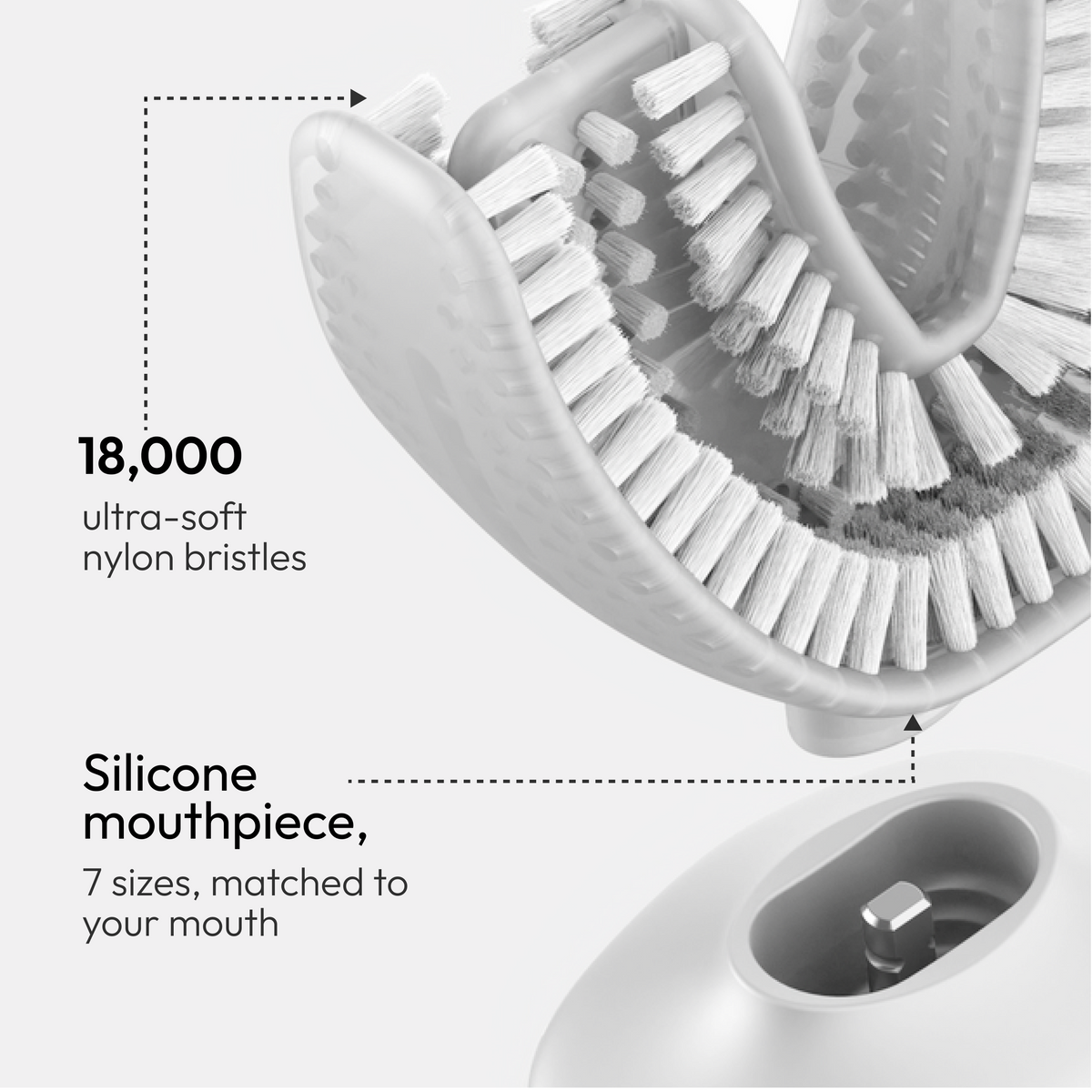
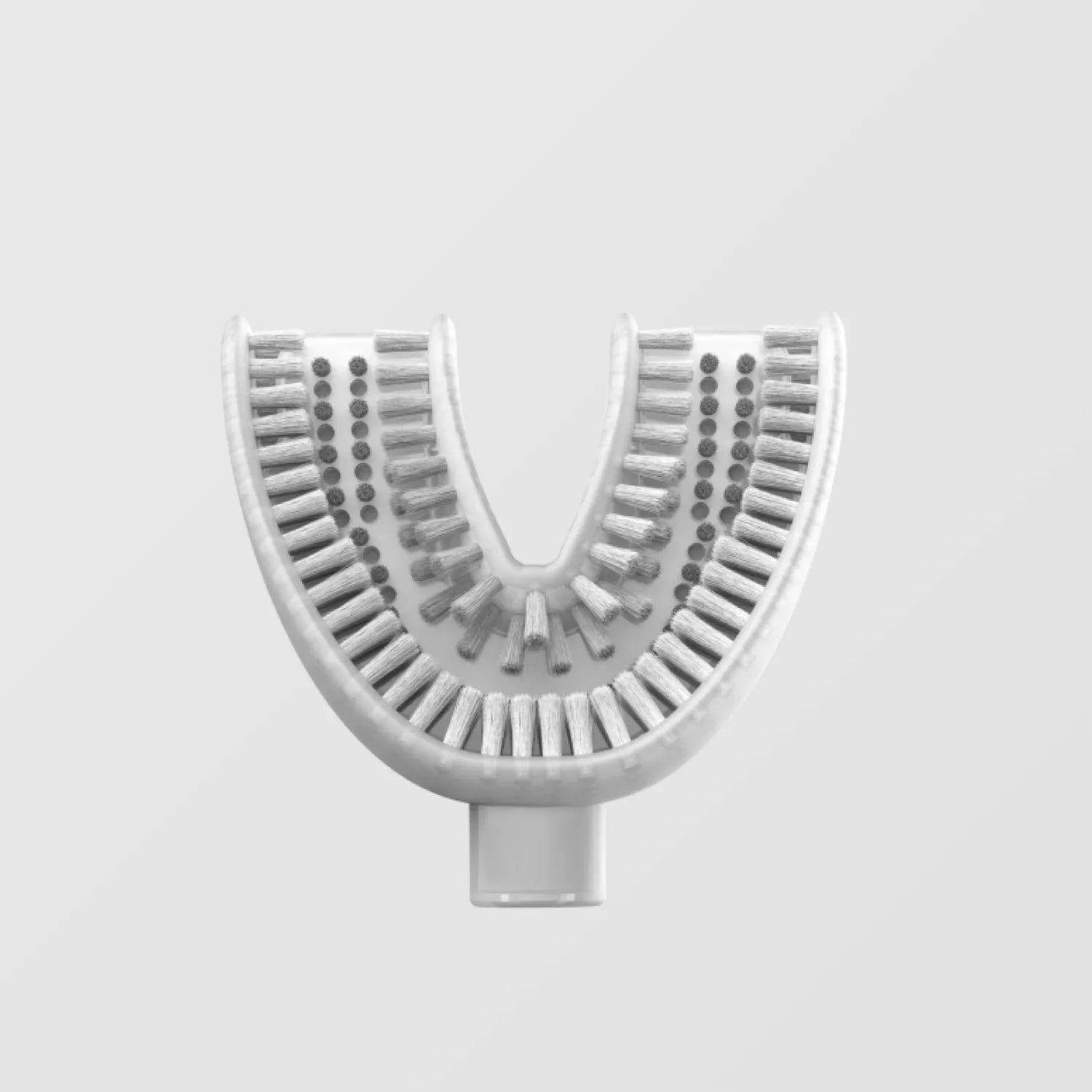
The TrueFit Mouthpiece is built around coverage. It comes in seven sizes, each with about 18,000 ultra-soft nylon bristles on a flexible plate that adapts to your dental arch, and the Feno Smartbrush is designed to clean all accessible tooth surfaces at once in a 20-second cycle. The app can capture images of your gumline and teeth so you can track changes over time. Those are product features, not clinical findings. Independent trials of other U-shaped and automatic brushes have mostly found less plaque removal than manual brushing, and none of them tested Feno. Feno's post on why toothbrush fit and design matter covers that research.
A toothbrush cleans teeth; it doesn't treat gum disease, and no brush replaces cleaning between your teeth or a dental exam. Feno's own guidance is to keep flossing once a day, and to check with your dentist before using the Smartbrush if you already have gum recession, gum sensitivity, or another gum condition. If your gums bleed, look red or swollen, feel tender, or your teeth feel loose, book the appointment. Staging happens in the chair, not at home.
Two minutes, twice a day, fluoride toothpaste, daily cleaning between teeth, and a dental visit at least yearly are the habits that keep gingivitis from becoming a stage.
The Bottom Line
Frequently Asked Questions
What Are the Stages of Gum Disease?
Can Gum Disease Be Reversed?
How Do Dentists Know Which Stage You Are In?
What Does Grade A, B, or C Mean?
Featured Posts
View all
Feno vs Autobrush vs Y-Brush: U-shaped toothbrushes compared
Read article
Toothbrush Head Size: Does Bigger or Smaller Clean Better?
Read article
Floss before or after brushing? The right order, explained
Read article
What Dentists Are Saying About Feno
Read article
Why Does Bad Breath Come Back After Brushing?
Read article