

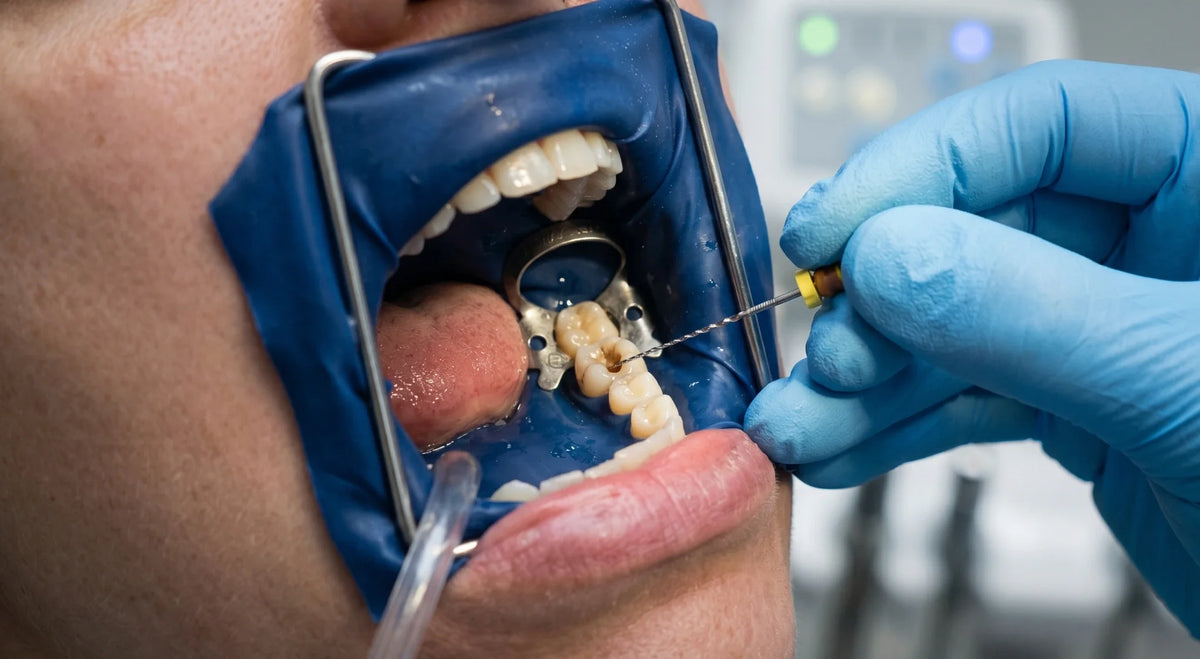
Root canals have a reputation. Most people walk in expecting pressure, maybe some soreness, maybe a little tenderness afterward. What they don't expect is a sudden sharp or electric sensation, the kind that makes your hands grip the armrests seemingly coming out of nowhere mid-procedure.
If that's happened to you, you're not imagining it. Unusual sensations during root canal treatment are more common than most patients realize, and while they can be startling, they're almost always explainable. Understanding what's actually happening, and when something warrants a closer look can make the whole experience feel considerably less alarming.
TL;DR
- Sharp or electric sensations during root canal treatment are typically caused by irritation to pulp or nearby nerve tissue, not brain injury. Persistent numbness, tingling, or pain after the procedure is rare but should be evaluated and documented by your endodontist.
Chapter 1 of 5
What Do These Sensations Feel Like?
Patients describe them in different ways. Some say it feels like a brief electric shock. Others describe a sharp, shooting feeling that travels up through the jaw or seems to radiate toward the eye or cheek. Some use the phrase "brain zap", a term borrowed from experiences with medication withdrawal, but one that captures the sudden, disorienting quality well.
Others report a deep, unexpected pressure, a dull throb that spikes without warning, or a fleeting numbness in the lip or cheek. These are all variations on the same underlying phenomenon: the nervous system responding to something occurring in or near the root of the tooth.
It's worth being clear about terminology here. "Brain zap" is a patient-reported description, not a clinical term, and these sensations are not originating from the brain. They arise from peripheral nerve tissue most commonly branches of the trigeminal nerve, and are perceived as sharp or electric in quality because of how that nerve system processes and transmits sensation.
Chapter 2 of 5
Why Do These Sensations Happen?
To understand what's going on, it helps to understand the anatomy involved.
Each tooth contains a pulp chamber extending down into the root canals. Running through those canals is the dental pulp connective tissue, blood vessels, and nerve fibers. Root canal treatment involves removing infected or inflamed pulp, cleaning and shaping the canals, and sealing them. That process requires working in close proximity to, or directly within, live or partially live nerve tissue.
Several things can trigger a sudden sensation during this process:
Mechanical irritation from instrumentation. Endodontic files are used to shape the canal from the inside. If a file extends slightly past the apical foramen, the small opening at the root tip it may contact the periapical ligament or surrounding tissue, producing the characteristic electric or shooting feeling. This is one of the recognized causes of nerve-related sensation during endodontic treatment.
Chemical irritation from irrigants. Solutions like sodium hypochlorite are used to disinfect the canal space. If irrigant reaches the periapical tissue just beyond the root tip, it can cause sharp, stinging, or burning discomfort. In rare cases, irrigant extrusion beyond the apex can cause more significant irritation, which is why managing irrigation pressure carefully is a standard part of endodontic technique.
Incomplete anesthesia. Teeth with active infections are notoriously difficult to fully anesthetize. Inflammation lowers tissue pH, which reduces the effectiveness of local anesthetics. Certain nerve blocks may not capture every branch serving a particular tooth. The result is a patient who is partially numb enough for most of the procedure, but not fully covered when the instrument reaches a particularly sensitive area. Supplemental anesthesia is often needed in these cases.
Pressure changes within the canal. Even without direct nerve contact, pressure fluctuations during instrumentation or irrigation can transmit sensation through the periapical tissues.
Referred sensation along trigeminal pathways. The trigeminal nerve, the primary sensory nerve of the face and mouth has three main branches with extensive overlap. Stimulation at one point can produce sensations felt elsewhere, which is why an event during treatment on a lower molar might briefly feel like it's coming from the cheek or behind the eye.
Chapter 3 of 5
Does It Mean Something Went Wrong?
In most cases, no. A brief sharp or electric sensation during root canal treatment is a known phenomenon, not an automatic sign of error. The periapical tissues are richly innervated, root anatomy varies significantly between patients, and the instruments and irrigants involved are working in a very small, sensitive space.
That said, not all sensations are equivalent.
A momentary jolt that resolves immediately is very different from pain or altered sensation that persists after the procedure ends. While most patients recover without complication, endodontic treatment can on rare occasions cause nerve-related symptoms including paresthesia (numbness or reduced sensation), dysesthesia (altered or unpleasant sensation), or tingling particularly when the inferior alveolar nerve or one of its branches is involved. These outcomes, though uncommon, are documented in the literature and should be evaluated and managed, not dismissed.
(Journal of the Canadian Dental Association)
The important distinction is this: these are peripheral nerve events, not brain injuries. The brain has no pain receptors and is not affected by the mechanisms involved in root canal treatment. If the sensation you experienced was frightening, that's completely understandable, but it does not reflect anything reaching or affecting brain tissue.
Chapter 4 of 5
What You Should Do
During the procedure: Tell your endodontist. You don't need to diagnose what's happening, that's their role but they need to know what you're feeling, when, and where. Good practitioners will adjust accordingly: repositioning instruments, supplementing anesthesia, modifying irrigation pressure, or pausing to let you settle.
After the procedure: Some soreness in the first 24 to 72 hours is expected. Over-the-counter anti-inflammatories typically manage this well. What you're watching for is anything disproportionate: severe pain that isn't responding to standard relief, swelling that worsens rather than resolves, or any persistent numbness, tingling, or altered sensation in the face, lips, chin, or tongue.
If something feels off: Contact your endodontist and describe specifically what you're experiencing. Don't wait hoping it will resolve on its own, in the unlikely event of nerve involvement, earlier evaluation leads to better outcomes.
In the days following: Your tooth and surrounding tissue are recovering. Keeping your mouth clean during this window matters more than people often think bacteria from the broader oral environment can complicate healing at a vulnerable site. Staying consistent with thorough, gentle brushing is worth the effort, even when your mouth is still sensitive. Tools designed to reduce the friction of brushing, like the Feno Smartbrush, which cleans all surfaces simultaneously in 20 seconds, can make post-procedure oral hygiene more manageable.
Chapter 5 of 5
Symptoms That Warrant Follow-Up
Most strange sensations during a root canal are brief, explainable, and not a sign of lasting harm. Contact your endodontist if you notice any of the following:
- Severe pain not responding to standard pain relief in the first few days
- Swelling that continues to increase after 48 to 72 hours
- Persistent numbness, tingling, burning, or altered sensation in the lips, chin, cheek, or tongue
- Any sensation during the procedure that felt significantly more intense than expected, particularly a sudden burning or swelling during irrigation
When you follow up, document what you experienced: when during the procedure it occurred, what it felt like, and how long it lasted. This is genuinely useful clinical information that helps your provider determine whether any further imaging or evaluation is needed.
Root canal treatment is one of the most commonly performed dental procedures, and the large majority go without significant complication. Strange sensations, when they do occur, are almost always a function of the complex anatomy involved, not evidence that something went seriously wrong. Knowing that doesn't make the experience any less surprising, but it does make it easier to interpret accurately and respond to appropriately.
Featured Posts
View all
Feno vs Autobrush vs Y-Brush: U-shaped toothbrushes compared
Read article
Toothbrush Head Size: Does Bigger or Smaller Clean Better?
Read article
Floss before or after brushing? The right order, explained
Read article
What Dentists Are Saying About Feno
Read article
Why Does Bad Breath Come Back After Brushing?
Read article