

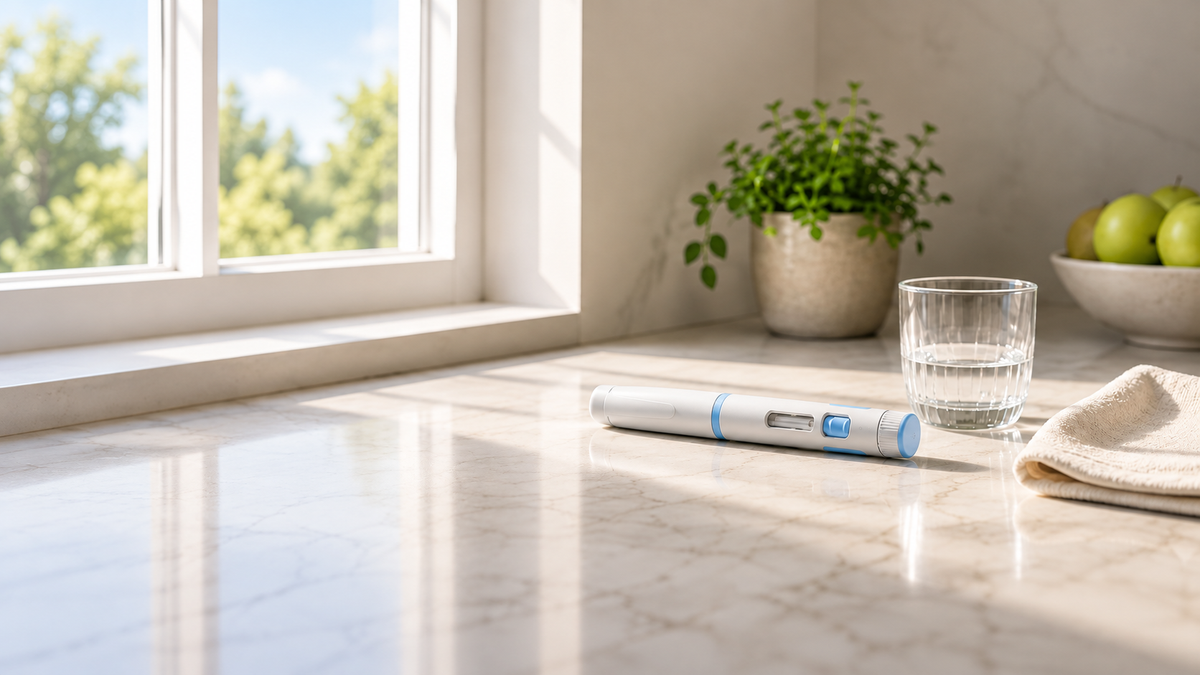
Ozempic.
Wegovy.
Mounjaro.
Zepbound.
GLP-1 medications have changed the conversation around diabetes and weight management.
Now another phrase is starting to show up online:
“GLP-1 mouth.”
Depending on where you see it, the term may refer to dry mouth, bad breath, cavities, gum sensitivity, enamel changes, or simply a mouth that feels different after starting treatment.
But there is an important distinction to make immediately:
“GLP-1 mouth” is not a recognized medical diagnosis.
It is a popular shorthand being used to describe a collection of possible oral symptoms.
And the emerging data is more complicated than the nickname makes it sound.
TL;DR
- “GLP-1 mouth” isn’t a medical diagnosis. Dry mouth appears to be one of the more commonly reported oral issues, but the early research is much more nuanced than the social-media term suggests.
Chapter 1 of 6
Dry Mouth May Be the Clearest Signal So Far
A large 2026 electronic-health-record analysis looked at oral outcomes among 184,582 people using GLP-1 receptor agonists.
The most frequently recorded new oral condition was dry mouth, at 5.29%.
But here’s the surprising part.
When researchers compared matched GLP-1 users with people taking other diabetes medications, GLP-1 users actually had lower recorded rates of dental caries and periodontitis.
They did, however, have a higher rate of plaque and calculus diagnoses.
That doesn’t fit the simple internet narrative that these medications are universally “ruining people’s teeth.”
And there is another major caveat:
The analysis is a preprint. It has not yet gone through peer review.
Electronic medical records can also miss dental care that happens outside the medical system, and associations in this kind of data cannot prove that a medication directly caused or prevented an oral condition.
Chapter 2 of 6
Why Might Your Mouth Feel Different Anyway?
GLP-1 medications can cause gastrointestinal side effects such as nausea and vomiting.
Reviews discussing dental management of patients using these drugs have raised several possible oral consequences, including xerostomia, altered taste, halitosis, and erosion related to repeated vomiting or reflux.
But many of these pathways may be indirect rather than a direct drug effect on the teeth themselves.
For example:
If you’re nauseous, you may drink less.
If you’re eating less, your routine may change.
If you’re vomiting repeatedly, stomach acid can contact the teeth.
And if your mouth becomes persistently dry, saliva’s protective role becomes more important.
Chapter 3 of 6
Saliva Does Much More Than Keep Your Mouth Comfortable
Saliva helps lubricate oral tissues, clear debris, and support the environment around your teeth.
Persistent dry mouth is associated with increased risk of tooth decay and oral infections.
That’s why a dry mouth that lasts shouldn’t simply be covered with stronger mints.
Talk with your dentist or prescribing clinician.
Medication dose, hydration, other medications, and underlying health conditions can all play a role.
Chapter 4 of 6
What Can You Do If Your Mouth Feels Dry?
Start simple.
Stay hydrated.
Use appropriate fluoride-containing dental products if your dentist recommends them.
Avoid constantly sucking on sugary candies to create saliva.
And consider sugar-free gum.
The American Dental Association notes that chewing sugar-free gum increases salivary flow, which can help clear food debris and neutralize plaque acids.
Feno Gum is sugar-free and formulated with organic xylitol and nano hydroxyapatite for daily oral-care support.
It isn’t a treatment for medication-induced dry mouth.
But chewing gives saliva a reason to start flowing, making gum a practical option when your mouth feels dry between brushing sessions.
Chapter 5 of 6
And Then There Are the Low-Energy Days
Anyone who has dealt with medication-related nausea knows the feeling.
You’re tired.
You don’t feel great.
The full nighttime routine suddenly feels like a much bigger task.
That doesn’t make oral hygiene less important.
It makes reducing friction more useful.
Feno’s Smartbrush uses a full-mouth TrueFit Mouthpiece and a programmed 20-second brushing cycle.
That doesn’t treat GLP-1 side effects.
But when energy is low, a shorter daily brushing routine may be easier to complete consistently.
Chapter 6 of 6
Don’t Let an Internet Nickname Diagnose Your Mouth
GLP-1 medications have genuine benefits and genuine side effects.
Oral health deserves to be part of the conversation, but without turning every cavity, dry-mouth episode, or bad-breath day into “Ozempic mouth.”
Pay attention to changes.
Tell your dentist what medications you’re taking.
And if your mouth suddenly feels different after starting a medication, bring it up.
The best response isn’t panic.
It’s adjusting your routine to what your mouth actually needs.
Featured Posts
View all
Feno vs Autobrush vs Y-Brush: U-shaped toothbrushes compared
Read article
Toothbrush Head Size: Does Bigger or Smaller Clean Better?
Read article
Floss before or after brushing? The right order, explained
Read article
What Dentists Are Saying About Feno
Read article
Why Does Bad Breath Come Back After Brushing?
Read article