

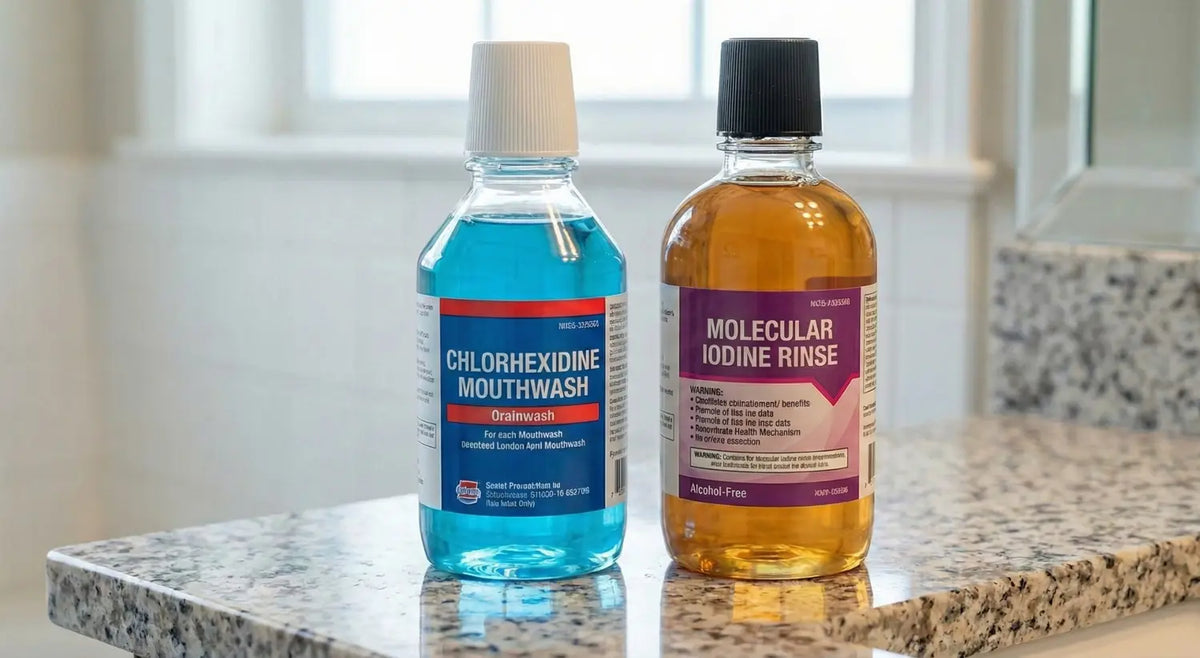
When you're dealing with gum disease or recovering from dental surgery, your dentist might recommend an antiseptic rinse. But you've probably noticed two names keep coming up: chlorhexidine and molecular iodine. They're not interchangeable and understanding the difference matters for your treatment.
The challenge? One has decades of clinical research behind it. The other is newer and shows promise, but with less head-to-head evidence. Here's what you actually need to know to make an informed choice with your dentist.
TL;DR
- Chlorhexidine is proven for short-term use; molecular iodine shows promise but has less evidence. Both need mechanical cleaning, brush consistently and use any rinse strategically under your dentist's guidance, not long-term.
Chapter 1 of 5
What Chlorhexidine Does (and What It Costs You)
The efficacy: Chlorhexidine (CHX) is considered the gold-standard antiseptic rinse in dentistry. Multiple systematic reviews and clinical trials confirm it's highly effective at reducing plaque and gingivitis when used as an adjunct to mechanical cleaning, meaning brushing, flossing, and interdental devices.
Research from the American Dental Association and European/international periodontal guidelines support chlorhexidine for specific, time-limited situations:
- Short-term management of active gingivitis or periodontitis (gum disease)
- Post-surgical wound care
- Situations where mechanical cleaning alone isn't controlling inflammation
The tradeoffs: Chlorhexidine's effectiveness comes with consistent side effects, especially with regular use:
- Tooth staining: Extrinsic (surface-level) discoloration is the most common complaint, typically appearing as a brown or yellow film on teeth.
- Taste disturbance: Many users report a metallic taste or a "numbing" sensation (hypogeusia).
- Mucosal irritation: Some people experience mild irritation of the gum tissue or inner cheek.
- Oral microbiome concerns: Long-term use may affect your natural oral bacterial balance and nitric oxide production (important for gum health).
These effects are usually reversible. They tend to fade when you stop using the rinse, but they're real enough that most dental guidelines recommend chlorhexidine only as a short-term, supervised adjunct, typically for 2-4 weeks, not as a long-term solution.
Chapter 2 of 5
Molecular Iodine: An Emerging Option (But Still Early)
The promise: Molecular iodine rinses are being positioned as a newer alternative that offers similar antimicrobial benefits with fewer side effects. The concept is attractive: iodine has broad-spectrum antimicrobial activity, and in theory, molecular iodine formulations deliver these benefits at very low free-iodine levels to reduce irritation.
The reality: Most of the actual clinical research isn't on "molecular iodine" specifically, it's on povidone-iodine (PVP-iodine), which has been used in periodontal and peri-implant care for years. While related, these aren't identical formulations, so the evidence isn't a direct 1:1 comparison.
What povidone-iodine research shows:
- Comparable antimicrobial effectiveness to chlorhexidine for wound healing and microbial control after implant surgery
- Lower incidence of tooth staining and taste disturbance compared to chlorhexidine
- Good safety profile when used topically, with few systemic side effects and contraindications
- Notably, it didn't outperform chlorhexidine in head-to-head trials, it was about equal, but better tolerated.
For proprietary "molecular iodine" mouthrinses specifically, peer-reviewed periodontal trials comparing them directly to chlorhexidine in gum disease treatment are still limited. Much of the "fewer side effects" narrative comes from extrapolating povidone-iodine data plus early product-specific reports, not large, long-term randomized trials.
(Molecules, 2024)
Bottom line: Molecular iodine is an emerging option worth discussing with your dentist, especially if you're sensitive to chlorhexidine's side effects. But it's more accurate to frame it as "promising adjunctive approach with early data" rather than a definitively superior alternative. The evidence just isn't there yet.
Chapter 3 of 5
The Non-Negotiable Truth: Rinses Don't Replace Mechanical Cleaning
Whatever rinse you choose, accept this fundamental reality: you cannot rinse your way to healthy gums.
Systematic reviews on plaque control consistently show that mechanical plaque removal, brushing, flossing, and interdental cleaning - is the primary method for controlling plaque and inflammation. Chemical agents, whether chlorhexidine or iodine-based, are adjuncts for specific indications, not substitutes.
Studies on periodontal patients demonstrate that daily mechanical cleaning with appropriate technique reduces plaque and gingival inflammation more effectively than any rinse alone. The rinse supports your brushing routine; it doesn't replace it.
Chapter 4 of 5
How to Use These Rinses Safely
If your dentist recommends an antiseptic rinse, follow these principles:
Get professional guidance. Don't self-prescribe strong antiseptic rinses. Your dentist should specify which rinse, the concentration, frequency, and duration based on your specific condition.
Keep it short-term. Chlorhexidine, in particular, should be used for a defined period, typically 2-4 weeks not indefinitely. Long-term unsupervised use is not recommended.
Maintain gentle, consistent mechanical cleaning. Especially during treatment, you want to clean effectively without causing additional trauma. Consistent daily cleaning with appropriate pressure matters more than aggressive scrubbing. Powered toothbrushes, particularly those with pressure-control technology, can help you avoid over-brushing while still removing plaque effectively.
Watch for side effects. If you develop significant staining, taste changes, or mucosal irritation, report it to your dentist. There may be alternatives worth trying, or your rinse duration may need adjustment.
Don't assume longer is better. More aggressive or prolonged use of strong antiseptic rinses doesn't improve outcomes; it just increases side effects and microbiome disruption.
Chapter 5 of 5
So Which One Should You Use?
There's no universal answer, it depends on your specific situation.
Chlorhexidine is the well-established choice if:
- You have active gum disease requiring supervised short-term treatment
- You're recovering from periodontal or implant surgery
- You can tolerate its side effects for 2-4 weeks
- Your dentist has determined it's appropriate for your condition
Molecular iodine might be worth discussing if:
- You're sensitive to chlorhexidine's staining or taste effects
- Your dentist is familiar with iodine-based rinses and considers them appropriate for your situation
- You understand that you're choosing a newer option with less long-term clinical data
Neither works without solid fundamentals: Whichever rinse you use, its effectiveness depends on daily mechanical cleaning. Brushing twice daily with an effective technique, flossing or using interdental brushes, and maintaining consistency even after the rinse course ends.
Disclaimer: This content is educational and evidence-based. It's not a substitute for professional dental advice. Always follow your dentist's specific recommendations for antiseptic rinses, especially regarding which product, concentration, frequency, and duration are right for your situation.
Featured Posts
View all
Feno vs Autobrush vs Y-Brush: U-shaped toothbrushes compared
Read article
Toothbrush Head Size: Does Bigger or Smaller Clean Better?
Read article
Floss before or after brushing? The right order, explained
Read article
What Dentists Are Saying About Feno
Read article
Why Does Bad Breath Come Back After Brushing?
Read article