

Parkinson's disease is best known for its effects on movement, but its impact on oral health is significant and often overlooked. Tremors, muscle rigidity, and bradykinesia, the slowing of voluntary movement can turn a routine like toothbrushing into a genuine challenge. When daily oral hygiene becomes harder to maintain consistently, plaque builds up more easily, and the risk of cavities, root caries, and periodontal disease rises. Research, including a 2025 narrative review in NPJ Parkinson's Disease, confirms that people with Parkinson's tend to have poorer oral health outcomes compared to the general population, with higher rates of gum disease and tooth decay.
(Verhoeff MC, Eikenboom D, Koutris M, de Vries R, Berendse HW, van Dijk KD, Lobbezoo F. Parkinson's disease and oral health: A systematic review. Arch Oral Biol. 2023)
Saliva-related symptoms are another common concern. Many people with Parkinson's experience both drooling (sialorrhea) and dry mouth (xerostomia), and the two can actually coexist. Drooling in Parkinson's is largely driven by impaired swallowing rather than excess saliva production, the mouth accumulates saliva that isn't being cleared efficiently. Dry mouth, on the other hand, is often a side effect of dopaminergic medications and autonomic dysfunction. Both conditions affect oral health in meaningful ways: dry mouth accelerates cavity risk by reducing saliva's natural protective role, while persistent drooling can irritate the skin and soft tissues around the mouth.
(Isaacson J, Patel S, Torres-Yaghi Y, Pagán F. Sialorrhea in Parkinson's Disease. Toxins (Basel). 2020)
Swallowing difficulties and changes in facial muscle coordination can also shift eating habits over time. When chewing and swallowing become uncomfortable or inefficient, people may gravitate toward softer, often more processed foods, a dietary pattern that can affect both nutrition and oral hygiene.
(Umemoto G, Furuya H. Management of Dysphagia in Patients with Parkinson's Disease and Related Disorders. Intern Med. 2020)
The good news is that oral health can still be well-managed with the right adaptations. Evidence-based guidance for people with Parkinson's consistently points to a few key strategies: powered or electric toothbrushes to compensate for reduced dexterity and tremor, scheduling brushing during "on" periods when motor function is at its best, practicing technique with both hands to work around rigidity, and maintaining regular professional cleanings to catch problems early. Caregivers and dental providers play an important role in supporting these routines as the disease progresses.
(Martimbianco ALC, Prosdocimi FC, Anauate-Netto C, Dos Santos EM, Mendes GD, Fragoso YD. Evidence-Based Recommendations for the Oral Health of Patients with Parkinson's Disease. Neurol Ther. 2021)
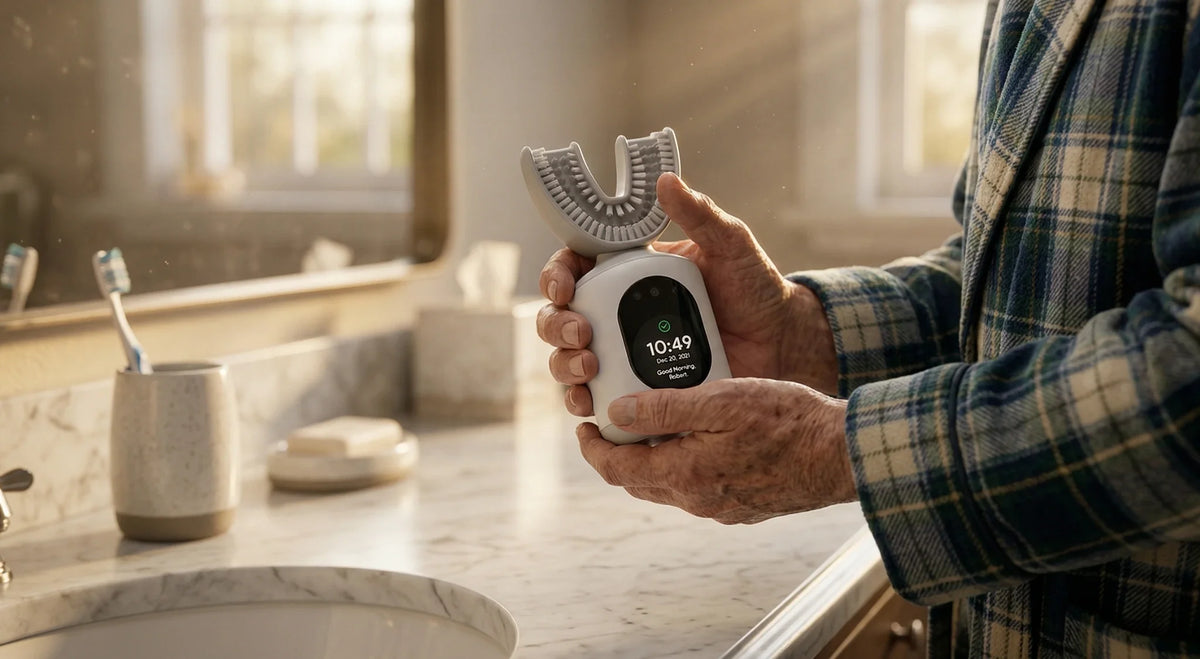
Tools that reduce the physical demands of brushing can make a real difference in day-to-day consistency. The Feno Smartbrush, with its 18,000-bristle design and 20-second full-mouth cleaning cycle, is one option worth considering for those who find prolonged manual brushing difficult.
With the right support and adaptive strategies, protecting oral health remains entirely achievable, even as Parkinson's disease presents new challenges along the way.
TL;DR
- Parkinson's disease raises the risk of cavities, gum disease, and salivary issues by making oral hygiene physically harder to maintain. Adaptive tools like electric toothbrushes, strategic timing, and regular dental visits can help people with Parkinson's protect their oral health effectively.
Featured Posts
View all
Feno vs Autobrush vs Y-Brush: U-shaped toothbrushes compared
Read article
Toothbrush Head Size: Does Bigger or Smaller Clean Better?
Read article
Floss before or after brushing? The right order, explained
Read article
What Dentists Are Saying About Feno
Read article
Why Does Bad Breath Come Back After Brushing?
Read article